Explore Crisil, a company of S&P Global
Formerly known as Global Research & Risk Solutions
August 01, 2025
 Blog
Blog
Blog
Biodiversity risk assessment: A strategic imperative for Financial Institutions and Corporates
August 01, 2025
Blog
Blog
 Share
Share



As the global conversation around sustainability evolves, biodiversity is emerging as a core business and financial risk driver. Nature loss is no longer a peripheral issue - it poses direct threats to operational continuity, asset value, and long-term portfolio performance. For financial institutions and corporates, assessing and managing biodiversity-related risks is not only a compliance requirement, but a strategic necessity.
Biodiversity underpins our economy - natural ecosystems deliver services (food, clean water, pollination, climate regulation) worth an estimated $125-140 trillion per year (about 1.5× global GDP)* ; Yet nature is collapsing.- World Wide Fund for Nature (WWF) reports an average 69% decline in wildlife populations since 1970. More than 50% of global GDP is highly or moderately dependent on nature, and the World Economic Forum (WEF) warns ~$44 trillion (over half of GDP) is exposed to biodiversity loss by 2030. In concrete terms, entire sectors - agriculture, forestry, fisheries, food & beverage - are 100% nature-dependent. These trends mean that as ecosystems degrade, businesses face real financial risks.
Nature-related financial risks arise from a company’s dependencies on ecosystem services (e.g. water, pollination) and its impacts on ecosystems (e.g. deforestation, pollution). For example, a farm is highly dependent on pollinators and soil fertility, whereas a mining operation can greatly impact water quality. The Taskforce on Nature-related Financial Disclosures (TNFD) defines nature-related risks as potential threats from those dependencies and impacts. These include:
- Physical risks - arising from ecosystem degradation (e.g. loss of pollinators, droughts, or deforestation reduces resource supply).
- Transition risks - arising from changing regulations, technologies, or markets as society shifts toward protecting nature (e.g. new environmental laws, consumer preferences for sustainable products).
- Systemic risks - cascading collapse of entire ecosystems (e.g. coral reef die-off) that trigger chain effects across economies.
Financial institutions face credit and market exposure through lending and investment portfolios, while corporates risk supply chain interruptions and reduced licenses to operate. Understanding these risks is the first step toward mitigation.
Global frameworks now explicitly call for biodiversity risk management. For instance, Target 15 of the Kunming-Montreal Global Biodiversity Framework urges companies to “regularly monitor, assess and transparently disclose their risks, dependencies and impacts on biodiversity along their operations, supply and value chains.” Similarly, the EU’s Corporate Sustainability Reporting Directive (ESRS E4) and SEC/ISSB developments will require nature disclosures. Investors, regulators and customers now expect businesses to identify and manage biodiversity-related risks and opportunities.
Structured approach to biodiversity risk assessment
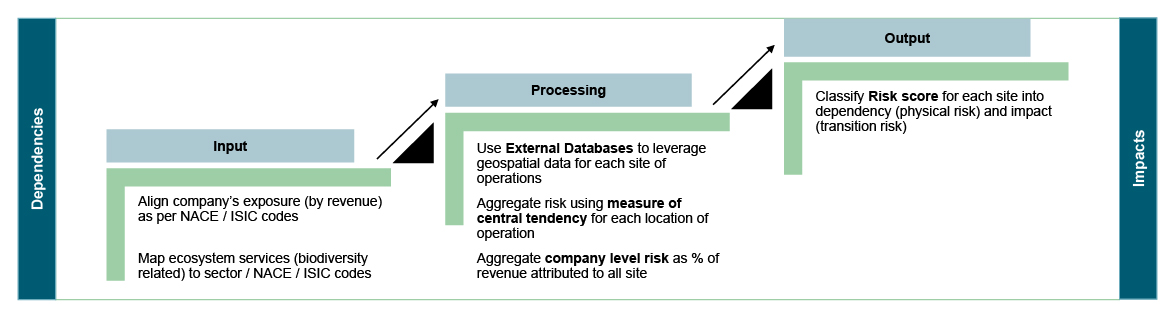
A typical biodiversity assessment proceeds in steps, combining financial portfolio data with environmental data:
- Map inventory assets and exposures: Gather portfolio or company data on sectors, geographies, financing or operations (e.g. loan book, supplier list, facilities). Map each asset or project to locations on earth (e.g. by coordinates, country, biome). Leverage land-use and protected area maps to see if assets overlap critical habitats (e.g. tropical forests, wetlands).
- Identify dependencies: Determine which ecosystem services each activity relies on. For example, agriculture depends on water regulation, soil fertility and pollination; fisheries depend on healthy marine ecosystems. Tools like ENCORE or sector/ecosystem models (e.g. TEEB, WRI’s Aqueduct) can estimate dependency intensity by industry.
- Measure impact: Evaluate how each activity affects ecosystems. This might include land conversion area (forest land deforested), water withdrawal, nutrient runoff, pollution, invasive species introduction, etc. Data sources include corporate disclosures, remote sensing (e.g. monitoring deforestation via satellites), and specialized databases (IUCN Red List status, WWF species data, national inventories).
- Calculate score and weight: Translate dependencies and impacts into quantitative scores. Many approaches assign each counterparty or investment a ‘Dependency’ score (how strongly it depends on a given ecosystem service or region’s biodiversity) and an ‘Impact’ score (how much pressure it exerts on those ecosystems). These can be normalized or weighed by exposure (investment size, revenue share) to produce comparable risk indicators.
- Identify hotspots: Use the scores to highlight high-risk areas. For instance, sectors like agriculture, mining or timber with operations in biodiversity-rich regions (e.g. Amazon basin, Congo basin, Southeast Asia) might emerge as hotspots. Scenario analysis (e.g. stress tests for habitat loss) can further stress-test portfolios.
Translating biodiversity insights into strategic action
Once organizations have a clear understanding of their biodiversity-related risks and opportunities, the next step is to integrate these insights into core business and financing activities. A robust biodiversity risk assessment serves as a foundation for action across multiple dimensions:
- Align lending and investment with nature outcomes:
Financial institutions can strengthen their risk frameworks by encouraging borrowers to adopt nature-supportive practices, such as avoiding deforestation, shifting to regenerative agriculture, or reducing ecosystem degradation. Loan structures can be tailored to incentivize performance on biodiversity metrics - for example, through interest rate adjustments or eligibility criteria. Some banks have already introduced dedicated products that finance conservation or biodiversity-enhancing activities. Similarly, insurers and asset managers are beginning to evaluate biodiversity risks within portfolios, incorporating them into screening, valuation, and stewardship practices.
- Build portfolios around Nature-based Solutions (NbS):
Corporates and financiers can direct capital into projects that restore or enhance natural systems - including reforestation, watershed protection, soil regeneration, and climate-resilient agriculture. These investments not only mitigate environmental impact but also deliver measurable returns - such as improved productivity, enhanced carbon storage, or reduced operational risks. Financial institutions, particularly development banks, are increasingly exploring green bonds or blended finance structures to fund such projects.
- Establish measurable targets and transparent disclosures:
With a data-backed baseline in place, organizations can define credible biodiversity targets - such as reducing ecosystem degradation, enhancing natural capital across value chains, or preserving high-value habitats. These targets can be aligned with global nature frameworks and translated into key performance indicators. Regular monitoring and disclosure, structured around emerging standards like TNFD or CSRD, demonstrate accountability and build trust with regulators, investors, and other stakeholders.
- Integrate biodiversity into core business strategy:
Truly embedding biodiversity requires going beyond compliance. Leading organizations are beginning to realign their business models to reduce ecological pressures - whether by redesigning products for circularity, shifting to low-impact sourcing models, or working collaboratively with communities to promote sustainable land use. Nature-positive principles are also finding their way into enterprise planning and financial decision-making, with companies tracking nature-related metrics alongside conventional KPIs to drive long-term value creation.
Key Takeaways
- Biodiversity is a systemic risk. Nature underpins revenue for almost all industries, so its loss translates directly into financial risk. CEOs and boards must recognize biodiversity alongside climate as a core risk driver.
- Use proven frameworks and data. Adopt the TNFD LEAP process and PBAF guidance. Leverage global datasets (WWF, IUCN, ENCORE, IBAT, S&P, etc.) to quantify where dependencies and impacts lie.
- Score your portfolio/project. Develop or commission a scoring methodology (like Crisil’s dependency/impact model implementation) to rank counterparties by biodiversity risk. This highlights “hot” areas where intervention is needed.
- Turn insight into strategy. Use the assessment to integrate biodiversity into decision-making: adjust sectoral exposure, engage high-impact clients on action plans, and explore nature-friendly financing. Leading banks already offer biodiversity-linked loans, and more products will follow.
- Align with nature-positive goals. Beyond risk, seek opportunity: invest in regeneration and innovative business models. A nature-positive portfolio can improve brand, meet stakeholder demands, and potentially avoid the massive losses threatened by unchecked biodiversity loss.
Nature is the next frontier of ESG integration. By embedding biodiversity considerations into governance and strategy, firms not only mitigate risk but can gain a competitive edge. More importantly, they will contribute meaningfully to reversing nature loss, a challenge that is both urgent and existential.
*How investors can think about the value of nature (Source reuters.com)