

Other Sectors
Middle East disruptions to impact daily CGD sales volume by 8-10%
PNG I&C to be most hit due to high reliance on LNG imports; cost pass-through to cushion margins
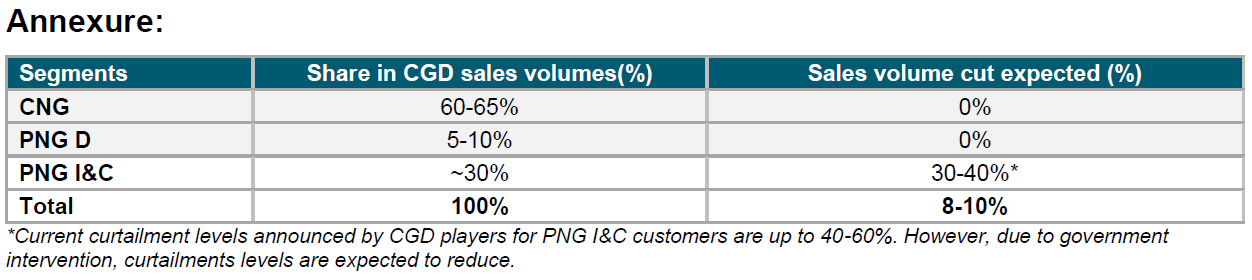
The city gas distribution (CGD) industry in India may see its daily sales volume moderate 8-10%, on reduced natural gas supply due to the ongoing conflict in the Middle East, until the situation stabilizes in the near term. All the same, ability to pass on price increases to end customers will cushion the CGD players’ profitability. Liquidity buffers, support from strong sponsors, and moderate leverage are likely to support the credit profiles of CGD players. However, prolonged uncertainty in the Middle East will remain monitorable.
Our assessment of seven CGD companies, together accounting for ~70% of the sales volume last fiscal, indicates as much.
For the record, the CGD industry relies on domestically produced natural gas for ~60% of its requirement, while imports account for the remaining ~40%.
The conflict has squeezed imports. Qatar, which accounts for ~45% of India’s liquefied natural gas (LNG) imports, has declared force majeure on international deliveries following a halt in production at its Ras Laffan facility on account of disruptions in the region. This has triggered a domino effect across the Indian gas value chain with several major gas traders invoking force majeure due to their inability to secure scheduled cargoes.
The CGD industry has three segments—compressed natural gas (CNG), piped natural gas – domestic (PNG D) and piped natural gas – industrial and commercial (PNG I&C). CNG and PNG-D together account for ~70% of the industry’s sales volume and are expected to be the least affected as natural gas supply for these segments largely comes from domestic sources. Besides, by invoking the Essential Commodities Act, 1955, the government has designated these two sectors as high-priority areas for natural gas allocation, as per a notification issued on March 9, 2026. However, PNG I&C, which contributes ~30% to the total sales volume, is expected to be affected the most due to its high dependence on imported gas.
Says Ankit Hakhu, Director, Crisil Ratings, “The industry's daily sales volume is expected to decline by 8-10% primarily due to curtailment of natural gas supply to I&C customers. This is despite likely government support1 to CGD companies to reduce curtailment to I&C customers from the current level of 40-50%. Meanwhile, Indian gas traders are seeking alternative sources to offset reduced LNG supply. However, limited excess supply in the export market and elevated spot prices pose a challenge. LNG facilities of key exporters are operating at 90-95% capacity (224 MTPA), leaving limited room for additional global supply (10-20 MTPA) to offset the absence of Qatar's 77-80 MTPA export volumes, if the situation prolongs.”
On the pricing front, CNG and PNG-D are not expected to be materially impacted as PNG-D demand is fully met through Administered Pricing Mechanism (APM) gas – capped at $6.75 per MMBtu – while demand for CNG segment is majorly met through a mix of regulated domestic gas supplies.
For PNG-I&C, which majorly depends on medium- to long-term supply contracts for imported LNG, prices are linked to a trailing period average of Brent crude prices. Reduction in supply under these contracts can lead to input cost pressure for CGD players as prices in Asian spot market have reached to $19-20 per MMBtu (from $10-11 per MMBtu in February 2026). However, the players have the ability to pass through such cost increases to end consumers.
Says Gauri Gupta, Team Leader, Crisil Ratings, “While the impact on operating margins is expected to be limited, the operating cash accruals of CGD players may moderate due to impact on volumes. However, credit profiles will be cushioned by healthy balance sheets of the players. The ratio of debt to earnings before interest, taxes, depreciation and amortisation is estimated to be ~1.0 time this fiscal as a result of larger players being debt free, with obligations towards annual capital expenditure and debt repayments being staggered over the medium term. Moreover, liquidity greater than 9 months of debt servicing and support from sponsors with strong credit profiles will provide resilience against near-term shocks.”
Wider demand-supply disequilibrium due to sustained disruption in Middle East facilities, higher spot prices of alternatives to natural gas, change in allocation to priority sectors and other government measures will bear watching.
1 The Government of India has issued the Natural Gas (Supply Regulation) Order, 2026 stating that Industrial and commercial consumers supplied via City Gas Distribution (CGD) networks are categorised under priority sector IV and will receive 80% of their past six-month average gas consumption subject to operational availability
Analytica